Space Robots Are Here *Now*, w/ Icarus Robotics cofounders Ethan Barajas and Jamie Palmer
Space robotics startup building teleoperated robots for spacecraft maintenance and cargo handling.
Guests
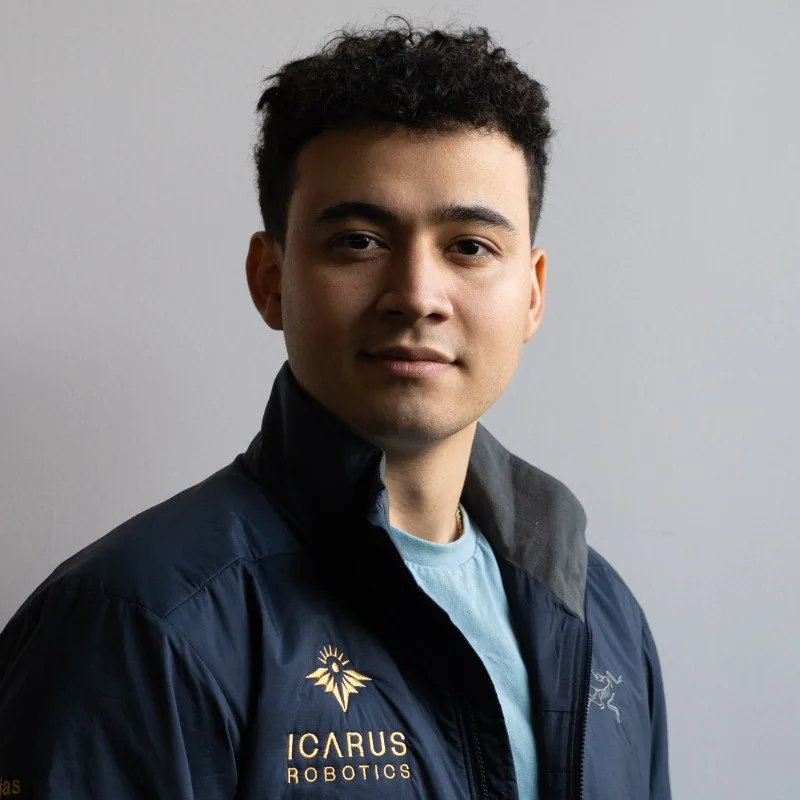
Ethan Barajas
Co-founder and CEO, Icarus Robots
Ethan Barajas is co-founder and CEO of Icarus Robots, a company developing teleoperated robots for work in microgravity. The company’s approach begins with cargo, inspection, and maintenance tasks, using human demonstrations to build data and gradually move toward safer autonomous manipulation in space.

Jamie Palmer
Co-founder and CTO, Icarus Robots
Jamie Palmer is co-founder and CTO of Icarus Robots, which develops agile, teleoperated robots for spacecraft. He leads the technical work behind free-flying platforms, dexterous manipulation, communications, and the collection of microgravity data needed to move from human-in-the-loop control toward autonomy.
About this conversation
What happens when “space robots” stop being sci-fi set dressing and start punching a clock? We dig into a new breed of microgravity robots that do the unglamorous work—so astronauts can do more science.
In this episode of AI-Curious , we talk with Ethan Barajas (CEO) and Jamie Palmer (CTO) , co-founders of Icarus Robots , fresh out of stealth with a $6M raise.
Their pitch is simple and radical: put agile, teleoperated robots inside spacecraft like the ISS to handle cargo, inspections, and maintenance—then use the resulting microgravity manipulation data to unlock partial (and eventually full) autonomy.
We cover the tech, the economics (why astronaut time is so expensive), the AI roadmap, and a pragmatic path from today’s chores to tomorrow’s orbital factories and lunar bases.
What we cover
• Why astronaut hours are precious—and how robots can “augment” rather than replace them
• The form factor: free-flying, drone-like bodies with dual arms optimized for zero-G dexterity
• Inside first, outside later: a deployment strategy that lowers safety hurdles and accelerates learning
• Data advantage: building the first large microgravity manipulation dataset via continuous teleop
• AI’s role: from human-in-the-loop control to primitives to scalable dexterous manipulation
• Communications and latency: S-band today, laser links tomorrow; what “real-time” actually means
• The “orbital factory” thesis: pharma, semiconductors, fiber optics—and servicing orbital data centers
• Long-horizon forecasts: humans living and working in space; physical labor increasingly done by robots